Category: Goldfish

  • Sole Survivor

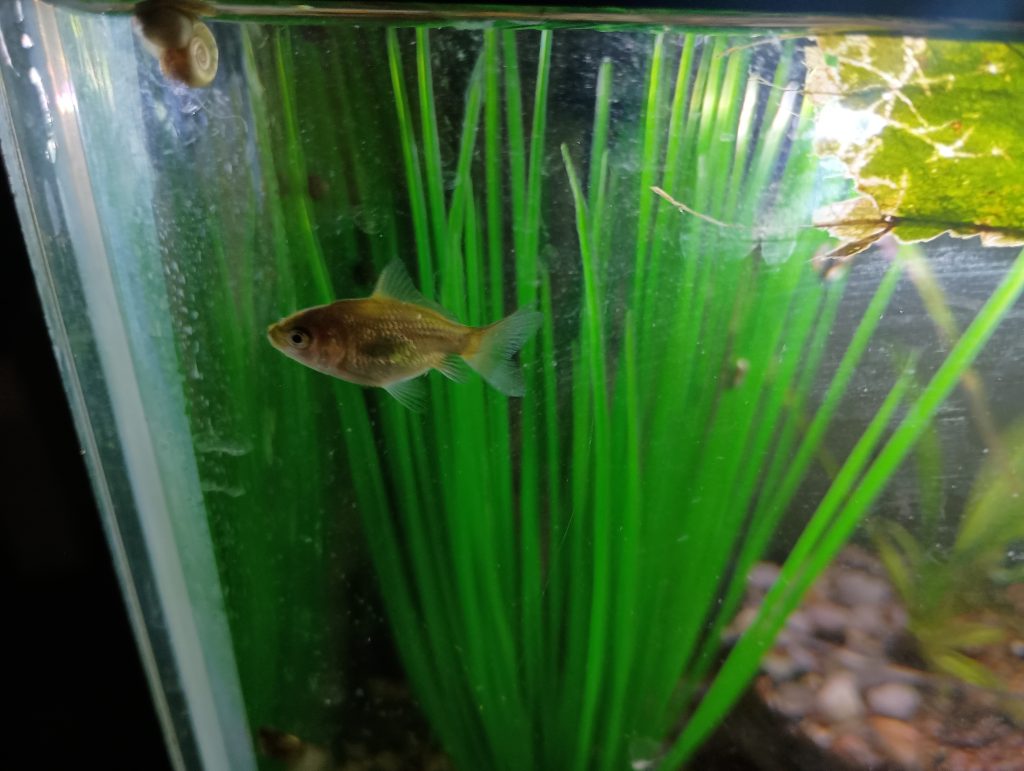
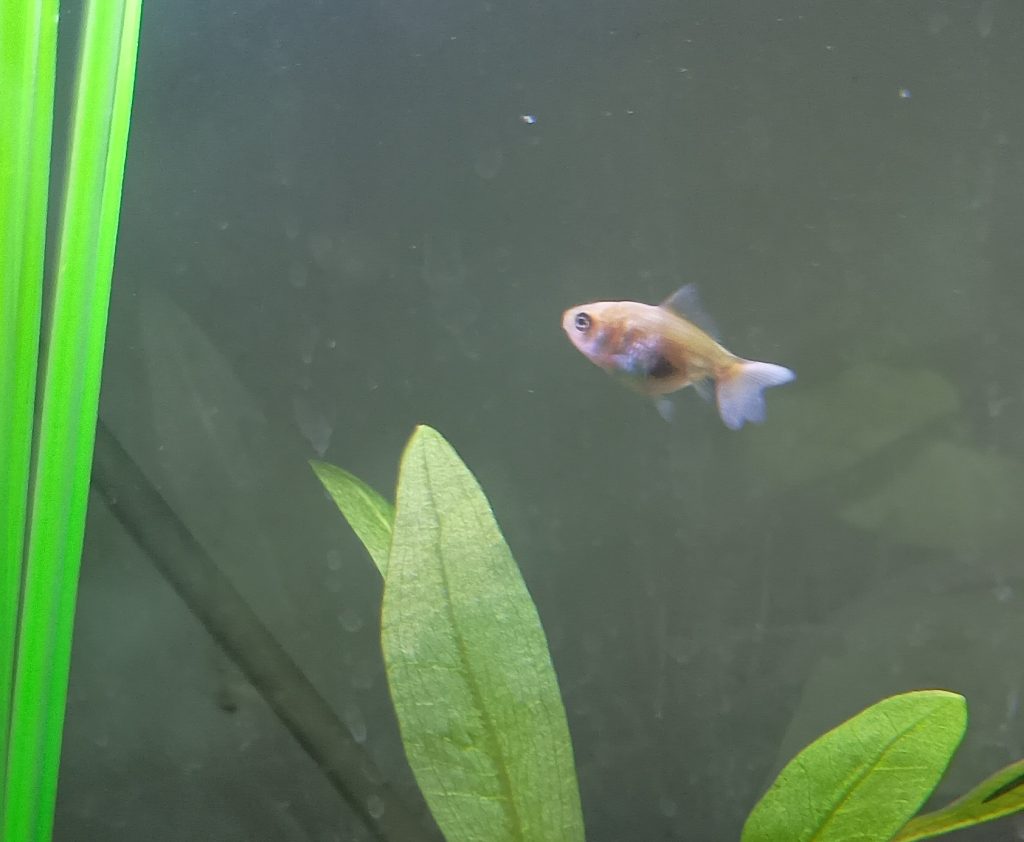
    It’s been about three weeks since I realized baby goldfish were growing in my snail tank. The sole survivor is thriving. I estimate she was three or four weeks old when I spotted her. That would make her around two months old, or so. She’s easily twice as big now and seems to have figured out that the big, white, air-breather on the other side of the glass is the source of food. She has stopped fleeing when I look into the tank and I can more easily get photos. In the latest, she appears more orange than in real life. To the eye, she’s a smoky, bluish purple. She can disappear into the plants when she wants to hide.

    There’s a bit of a problem in the snail tank and I’m anxious for baby goldie to get big enough to solve it. Goldfish will eat anything they can fit in their mouths, including snail eggs and recently hatched critters. I have two types of what are often called pest snails, pests because they reproduce like crazy and are difficult to evict. One is the bladder snail, small and so unattractive it should have been named the booger snail. The other is the rams horn snail, more attractive, but still able to overrun a tank. Both species can go from one to 100 quickly. And yes, one, not two; both can reproduce asexually. They eat algae and dead plants, so they’re not evil, just a nuisance.

    Apparently my big tank has bladder snails, but it’s not an infestation. Sometimes I find a couple of snails trapped in the gunk in my filter. I never see them in the main tank because the eggs and any baby snails get eaten by the fish. And so I’m hoping that the baby goldie will soon control the outbreak in the snail tank. I’ve seen PetSmart put goldfish in tanks to eradicate bladder snails. It can work. For now, she doesn’t seem to be eating many eggs and the snails are winning. If they get too far ahead, it might be hard for one fish to catch up.

  • And Then There Was One

    And then there was one.

    I haven’t seen the smaller of the two fish for several days. There was no floating body to be seen, but I figure the snails would have eaten him if he fell on the bottom of the tank. I guess there’s a high mortality rate for goldfish fry, so I can’t be surprised. I’m assuming he’s gone

    The survivor looks good to my untrained eye. He’s started eating from the surface instead of just eating little pieces of food headed toward the bottom. Something I read said to feed them plenty and often, so I do. But I think I’m mostly feeding the snails. He’s getting enough nourishment to grow and is now almost an inch long.

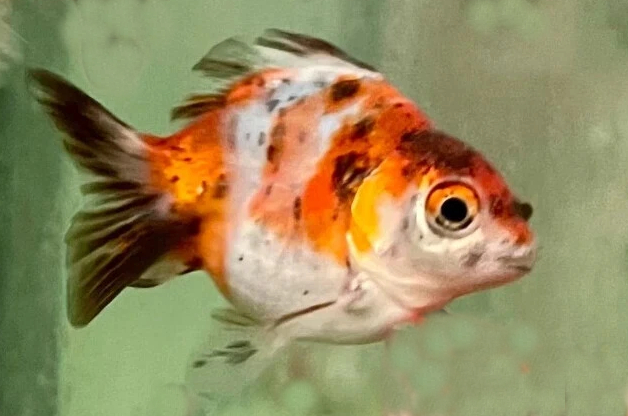
    He hides every time I slide the cover off the tank to feed him. I’m not sure how long it will take before he figures out that I’m the food guy. He still doesn’t look like a goldfish, but he looks like the pictures of other goldfish fry. I’m anxious to see what he, or she, looks like down the road. The mother is probably a red-cap oranda. The father could be any of a handful of suspects, from another couple of Orandas, one who is all orange, one who is white with a yellow cap to a calico fan tail.

    One of the interesting things about raising goldfish is that you never know what your adult fish will look like. My big orange Oranda was black and red when I got him, but that changed as he grew. Right now, the little guy is tan. Chances are pretty good that whatever color he first displays will just be a phase he’s going through. A lot of small goldfish seem to a lot of big, black areas, that often fade to orange. I see people complaining online about expensive panda orandas that turned into more common colors. Orandas are the goldfish sometimes described as having a second brain growing atop their heads. It’s known as a wen, which I think is Chinese for cap. The panda version is some combination of black and white. My brother had a panda oranda he named Amanda.

    Back to my little fry guy, there’s some chance he’ll be an oranda and a much greater chance he’ll be something else. I just hope he stays healthy and grows. I won’t be surprised, nor disappointed if at some point down the road I say, “This kind of homely guy over here was conceived in this tank and I’m pretty sure that’s his mother over there.”

  • Goldfish Daddy Day 4

    Little goldfish are boring. They barely venture out from hiding in the plants. And when they do, they just cautiously flit around a bit and go back into hiding. So why am I checking on them at least 10 times a day?

    They are half translucent and the other half is the color of the little gravel at the bottom. They’re hard to find among the plants and the camouflage. They don’t cooperate when I try to take attendance. It usually takes half the day before I get a glimpse of the two at the same time.

    It reminds me of my joking reaction when friends and family have brought home babies from the hospital. It’s the miracle of life. I get it. But does it do any tricks yet? Except this time the joke’s on me. I’m the guy checking 10 times a day to see how his little kids are doing.

    These two guys are kind of miraculous. Google says female goldfish lay up to 10,000 eggs. These are the only two left. I don’t know about the fittest, but surely survival of the luckiest. They seem to be doing well, which I guess means they aren’t floating upside down at the top and they seem to be eating.

    I feed them a pinch of crushed goldfish pellets a few times a day. I don’t know what they ate before I knew they were there. Algae, I guess and scraps of whatever I fed the snails? They are really small and I can see them eating the tiniest particles in the water. Maybe they ate snail eggs. I have mystery snails and nerite snails that I bought. Nerites are infamous for laying infertile eggs all over a tank. And I have some bladder snails, widely considered a pest snail, who also lay tiny eggs everywhere.

    If I’d known I had goldfish fry in there, I would have fed them.

    I spent a bunch of time down a rabbit hole on Google the last couple of days. Professional breeders might get 30 percent fry hatching from all those eggs, according to one estimate. Many breeders get 30 percent survival from those that hatch, according to another source. That would be 9 percent of the original 10,000 for serious breeders if both those estimates are right. First time breeders often get no survivors, according to another “guy on the internet.”

    I’m lucky to have two without trying, I guess. They could be three or four weeks old, based the online photos and videos. They’re not out of the woods yet. They’re in a tank with good water quality and a guy who feeds them several times a day. They are afraid of me, unlike their parents and the other big guys in the big tank who worship me as the God of Fish Pellets. We’ll see if we can get these guys from here back into the big tank.

  • I’m A Fish Daddy

    In an unlikely turn of events, I’m a fish daddy.

    I have a small tank, sort of a hospital/nursery tank for plants in the big tank,battered by the ravenous goldfish or for new plants hopefully growing strong roots for their turns vs. the fish.

    Several types of snails crawl around the bottom and sides of the tank. When I admit a plant to the hospital, the snails will fairly quickly find it and clean it of any traces of algae, kind of like the guys at a car wash who descend on clean cars to quickly wipe off any water droplets, not quite as fast as the car wash guys, but surprisingly quick for snails.

    There are several baby snails crawling around and I was checking them out the other night when I saw what I thought was insect larvae. Turns out they’re fish. Tiny fish, technically fry. Two that I know of.

    There have been no adult fish in this tank for at least six months so it wasn’t obvious how the little guys got there. They don’t look like goldfish, more like minnows you might see in a small stream, mini minnows. I scratched my head and went to bed.

    In the morning, the little fishies are still there. The only explanation I can think of is that some fertilized eggs attached to a plant and hitchhiked into the snail tank.

    I got a strong light out and they look a little like goldfish. They have tiny butterfly split tails, a defining characteristic of “fancy” goldfish. Single tail goldfish sell for less than $1 in pet stores. Nice fat fancies can sell for more than $100.

    It’s Spring and the house is warmer, so the water in the big fish tank is getting warmer, which triggers breeding behavior.

    Female goldfish get a raw deal. They can’t release their eggs at will. If the eggs don’t get released mama can die. On the other hand, the natural alternative is that they get chased around by males who will express the eggs rudely, often violently, by banging the girls against rocks, plants or whatever. Females can die from this courtship, as well. In almost 10 years of keeping goldfish, I’ve never had a girl die.

    I’ve also never had fry before.

    Goldfish will eat anything, including newly fertilized eggs and any young ones that might get so far as to hatch.

    I have no idea how many fertilized eggs made it into the snail tank. I assume snails enjoy fish eggs. All I know is that at least two got to the point of swimming around in a tank without predators. I have no idea what the chances are for them. Frankly it will be a hassle if they do survive. They will outgrow the snail tank long before they are ready for the ruckus of the big tank. Stay tuned.